
Internal Quality Assurance Cell (IQAC)
Home / IQAC
-
About IQAC
-
IQAC Director’s Message
-
Goal & Objectives
-
Functions
-
Compositions
-
Minutes of Meeting (MoM)
-
AAA @ ATR
-
Best Practice
-
Stratagic Plan
-
Policy Implementations and Revision
-
Activities
About IQAC
“QUALITY IS NEVER AN ACCIDENT. IT IS ALWAYS THE RESULT OF INTELLIGENT EFFORT” – {JOHN RUSKIN}
The IQAC of YBN University is committed to planning, guiding and monitoring the quality assurance, sustenance and enhancement activities of the University. In line with the vision and mission of the YBN University, the IQAC develops quality policies and standardization measures for the smooth functioning of the University. The IQAC has three subsidiary bodies:
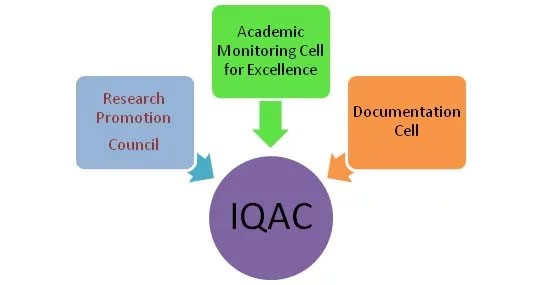
Internal Quality Assurance Cell (IQAC)
| Sl.No. | Subsidiary Bodies | Works / Responsibilities |
|---|---|---|
| 1 | ACADEMIC MONITORING CELL | Mainly for Excellence is entrusted with the task of administering the feedback mechanism. They collect the feedback, analyses it and submit to IQAC for forwarding to the Principal to take |
| 2 | RESEARCH PROMOTION COUNCIL (R&D) | It is in charge of promoting a research culture in the College. They organize workshops, seminars and conferences related to innovations in research methods, processes and practices. |
| 3 | DOCUMENTATION CELL | It collects the data relating to various activities of the College and help to form a Management Information System (MIS) to right decisions at the right time with less time and more accuracy. |
The Role of the DIRECTOR
The role of the Director of the IQAC is crucial in ensuring the effective functioning of all the members. The Director of the IQAC may be a senior/competent person with experience and exposure in quality aspects. She/he may be a full-time functionary or, to start with, she/he may be a senior academic /administrator entrusted with the IQAC as an additional responsibility. Secretarial assistance may be facilitated by the administration. It is essential that the Director may have sound knowledge about the computer, data management and its various functions such as usage for effective communication.
Operational Features of the IQAC
Quality assurance is a by-product of ongoing efforts to define the objectives of an institution, to have a work plan to achieve them and to specify the checks and balances to evaluate the degree to which each of the tasks is fulfilled. Hence devotion and commitment to improvement rather than mere institutional control is the basis for devising procedures and instruments for assuring quality. The right balance between the health and growth of an institution needs to be struck. The IQAC has to ensure that whatever is done in the University for “Education” is done efficiently and effectively with high standards. In order to do this, the IQAC will have to first establish procedures and modalities to collect data and information on various aspects of institutional functioning.
The Director of the IQAC will have a major role in implementing these functions. The IQAC may derive major support from the already existing units and mechanisms that contribute to the functions listed above. The operational features and functions discussed so far are broad-based to facilitate institutions towards academic excellence and institutions may adapt them to their specific needs.
The University needs to submit yearly the Annual Quality Assurance Report (AQAR) to NAAC by end of September every year positively. A functional Internal Quality Assurance Cell (IQAC) and timely submission of Annual Quality Assurance Reports (AQARs) are the Minimum Institutional Requirements (MIR) to volunteer for second, third or subsequent cycle’s accreditation. During the institutional visit the NAAC peer teams will interact with the IQACs to know the progress, functioning as well as quality sustenance initiatives undertaken by them.
The Annual Quality Assurance Report (AQAR) may be the part of the Annual Report. The AQAR shall be approved by the statutory bodies of the Higher Educational Institutes (such as Syndicate, Governing Council/Executive Council/Board of Management) for the follow up action for necessary quality enhancement measures.
The IQACs may create its exclusive window tab on its institutional website for keeping the records/files of NAAC, Peer Team Reports, AQAR, and Certificate of Accreditation Outcomes and regularly upload/ report on its activities, as well as for hosting the AQAR.
Objectives
- To develop a system for conscious, consistent and catalytic action to improve the academic and administrative performance of the institution.
- To promote measures for institutional functioning towards quality enhancement through internalization of quality culture and institutionalization of best practices.
Short term Goals
- To start new PG programmers in emerging technologies
- To promote quality research in all departments
- To establish of Centers of Excellences in all department
- To participate and excel in National Ranking through various agenciesg
- To be accredited by the National Assessment and Accreditation Council
- To Expand MoUs & Industry Linkage
- To Implement Tree Plantation, plastic free campus facility
Long term Goals
- To strengthen collaborations with leading Industries & foreign Universities
- To promote innovation, incubation, research and entrepreneur culture
- To achieve high NAAC Accreditation gradet
- To accomplish National & International recognition
Functions
Some of the functions expected of the IQAC are:
- Development and application of quality benchmarks
- Parameters for various academic and administrative activities of the institution
- Facilitating the creation of a learner-centric environment conducive to quality education and faculty maturation to adopt the required knowledge and technology for participatory teaching and learning process
- Collection and analysis of feedback from all stakeholders on quality-related institutional processes
- Dissemination of information on various quality parameters to all stakeholders
- Organization of inter and intra institutional workshops, seminars on quality related themes and promotion of quality circles
- Documentation of the various programmes/activities leading to quality improvement
- Acting as a nodal agency of the Institution for coordinating quality-related activities, including adoption and dissemination of best practices
- Development and maintenance of institutional database through MIS for the purpose of maintaining /enhancing the institutional quality
- Periodical conduct of Academic and Administrative Audit and its follow-up
- Preparation and submission of the Annual Quality Assurance Report (AQAR) as per guidelines and parameters of NAAC
Benefits
Will facilitate / contribute to:
- Ensure clarity and focus in institutional functioning towards quality enhancement
- Ensure internalization of the quality culture
- Ensure enhancement and coordination among various activities of the institution and institutionalize all good practices
- Provide a sound basis for decision-making to improve institutional functioning
- Act as a dynamic system for quality changes in HEIs
- Build an organized methodology of documentation and internal communication
Outcomes of IQAC Activities
- Accreditation – NAAC, ABET, ACBSP
- National Ranking – NIRF, QS I.GAUGE, FICCI
- International Ranking/Rating – QS, THE, QS BRICS, QS STAR
- AICTE Approval for professional courses
- UGC Graded autonomy
- Media Rankings
- MHRD All India Survey for Higher Education
- Swachh Bharat Summer Internship Program
- Swachhta Ranking
- Feedback from stakeholders
- Fully Flexible Credit System
- Curriculum for Applied Learning
- Promoting Technology Enhanced Learning – MOOC
- Annual Quality Assurance Report
Compositions
| Sl. No. | Name | Designation |
|---|---|---|
| 1 | Prof. Satyadeo Poddar, Vice-Chancellor | Chairperson |
| 2 | Dr. Kamal Kant Patra, Asst. Registrar, YBNU | Administrative Officer |
| 3 | Dr. Arpana Sharma, Dean Academics, YBNU | Senior Administrative Officer |
| 4 | Dr. Shravan Kumar Singh, COE, YBNU | Senior Administrative Officer |
| 5 | Dr. Rachna Kumari, Asst. Prof. School of C&M, YBNU | Faculty Member |
| 6 | Dr. Sammi Kesh Roy, Dean School of Legal Studies, YBNU | Faculty Member |
| 7 | Dr. A. Sumathy, Dean School of Nursing, YBNU | Faculty Member |
| 8 | Dr. Anjani Singh, Dean I/C School of Eng. & Tech YBNU | Faculty Member |
| 9 | Dr. Arti Gupta, Dean Student Welfare | Administrative Officer |
| 10 | Dr. Asha Mishra, Dean I/C School of Science, YBNU | Faculty Member |
| 11 | Dr. Kailash Nath Singh, HOD School of Education, YBNU | Faculty Member |
| 12 | Dr. Kalicharan Chaudhary, Principal MKHMCH, YBNU | Faculty Member |
| 13 | Dr. Dipak Jha, Principal School of Physiotherapy, YBNU | Faculty Member |
| 14 | Dr. Priti Kumari, R&D Co-Ordinator, YBNU | Faculty Member |
| 15 | Dr. Gholam Mursalin Ansari, Dean Computer Science & IT, YBNU | Faculty Member |
| 16 | Shri Ravi Shankar Kumar, Social worker & Politician | Nominee from Local Society |
| 17 | Dr. B.K. Jha, Principal Scientist, ICAR-RCER | Nominee from Research Centre |
| 18 | Dr. Deepak Kumar, Director, Akriti Biotech Pvt. Ltd. | Nominee from Industry |
| 19 | Miss Rani Kumari, 3rd Year, School of Pharmacy, YBNU | Student Member |
| 20 | Mrs. Anita Yadav, YBNU | Nominee from Alumni |
| 21 | Dr. Shyamdev Gond, Chief Librarian | Faculty Member |
| 22 | Mrs. Sapna Keshri, Principal, YBN School of Pharmacy, YBNU | IQAC-Coordinator |
| 23 | Prof. (Dr.) Ashish Sarkar, Dean School of Pharmacy, YBNU | IQAC-Director |